
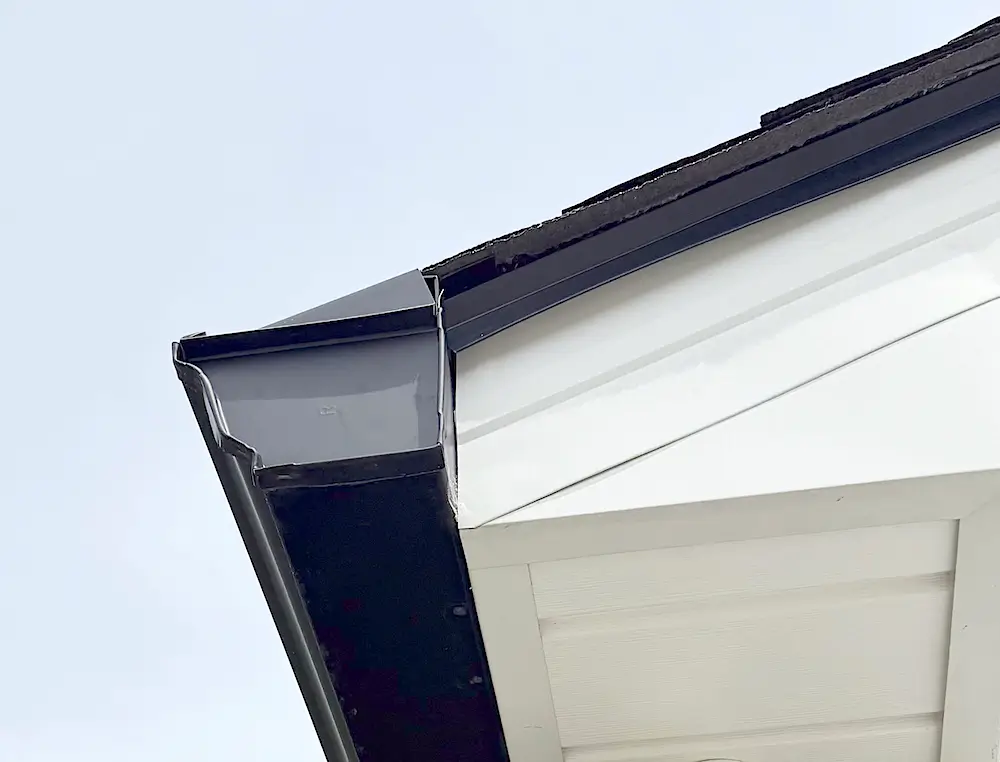
If you’ve shopped for gutters lately, you’ve almost certainly seen the term “K-style.” It’s the most common gutter profile on U.S. homes, and there’s a good chance the gutters on your roof right now are this style. Here’s a plain-English look at what they are and why they’re so popular.
Why are they called K-style?
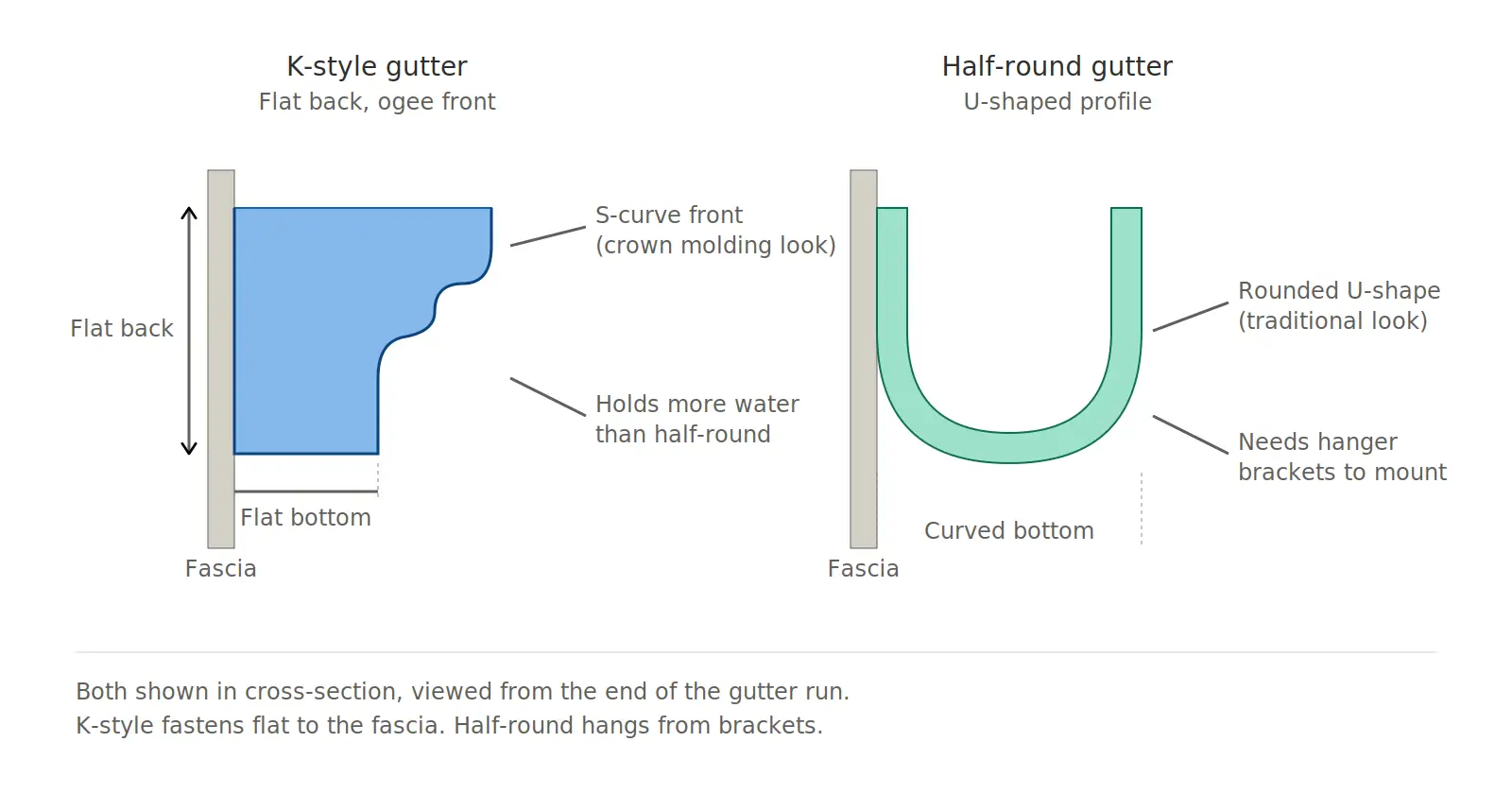
A K-style gutter has a flat back, a flat bottom, and a decorative front that curves in a shape similar to crown molding. From the side, the front edge has a soft S-curve (sometimes called an ogee).
A common misconception is that the name comes from the profile looking like the letter K. It doesn’t. SMACNA (the Sheet Metal and Air Conditioning Contractors National Association) created a list of standard rectangular gutter profiles labeled with letters, and this shape happened to land at number 11, the eleventh letter of the alphabet… K.
What Sizes do K-style Gutters Come in
Most homes in our area use 5-inch K-style gutters. Larger 6-inch versions are a popular upgrade for steeper roofs or properties that get heavy rain runoff. Wider 7-inch and 8-inch sizes exist but are mostly used on commercial buildings.
What are K-style gutters made of?
- Aluminum (the most common, lightweight and rust-resistant)
- Copper (long lifespan, premium look, higher cost)
- Galvanized or Galvalume steel (strong, heavier)
- Vinyl (lower cost, less durable in extreme weather)
Why do so many homeowners want K-style gutters?
A few reasons K-style gutters dominate residential installations:
- Capacity. The shape lets them carry more water than a half-round gutter of the same width.
- Looks. The crown-molding profile blends with most home styles.
- Installation. The flat back fastens directly to the fascia, which keeps the install simple.
- Availability. Most portable seamless gutter machines are built around the K-style profile, so contractors can roll continuous lengths (seamless gutters) on site.
Why would I need half-round gutters?
Half-round gutters, with their U-shaped profile and more traditional look are a great fit for older or historic homes. Keep in mind that they hold less water and usually cost more in materials and installation.
Frequently asked questions
Are K-style gutters stronger than half-round?
It depends on what you mean by stronger. The K-style profile is more rigid because of its angular shape, so it resists bending and denting better than a half-round made of the same material. That said, a heavier-gauge half-round in copper or steel, installed with quality brackets, can outlast a thin aluminum K-style. For most aluminum residential gutters, K-style is the more forgiving choice if a ladder or falling branch hits it, and it handles heavy Tennessee rain, snow and ice without a problem.
What size K-style gutter do I need?
5-inch K-style gutters are the residential standard, and they work for many homes in our area. But because the cost difference is small, we often recommend stepping up to 6-inch if any of these apply:
- Your roof is over about 2,000 square feet
- Your roof pitch is steeper than 6/12 (water moves faster and overshoots smaller gutters)
- You have long gutter runs of more than 40 feet between downspouts
- Multiple roof valleys feed into one section of gutter
- Your existing 5-inch gutters overflow during heavy storms
East Tennessee gets intense summer thunderstorms that can drop a lot of water in a short window, so for borderline cases we often recommend leaning toward 6-inch. The cost difference is small compared to repairing fascia damage from overflow or damage to the foundation.
How long do K-style gutters last?
A properly installed aluminum K-style gutter typically lasts 20 to 30 years. Copper K-style can last 50 years or longer. The biggest variables are install quality (proper slope and secure fasteners), regular cleaning, and how much tree debris your home gets. Sagging sections, separating seams, peeling paint, and visible rust are signs it’s time to replace.
Should I repair my existing gutters or replace them?
If the damage is limited to one section (a dented run, a loose downspout, a pulled-away bracket), a repair usually makes sense. If you’re seeing widespread sagging, leaks at multiple seams, or rust through the bottom, replacement is almost always the better long-term call. Get in touch for a free gutter assessment and we’ll give you an honest read on which makes sense for your home.
Bottom line
K-style gutters are popular because they handle water well, fit most home styles, and are practical to install. If you’re replacing or adding gutters, this is the profile most contractors will recommend by default.
